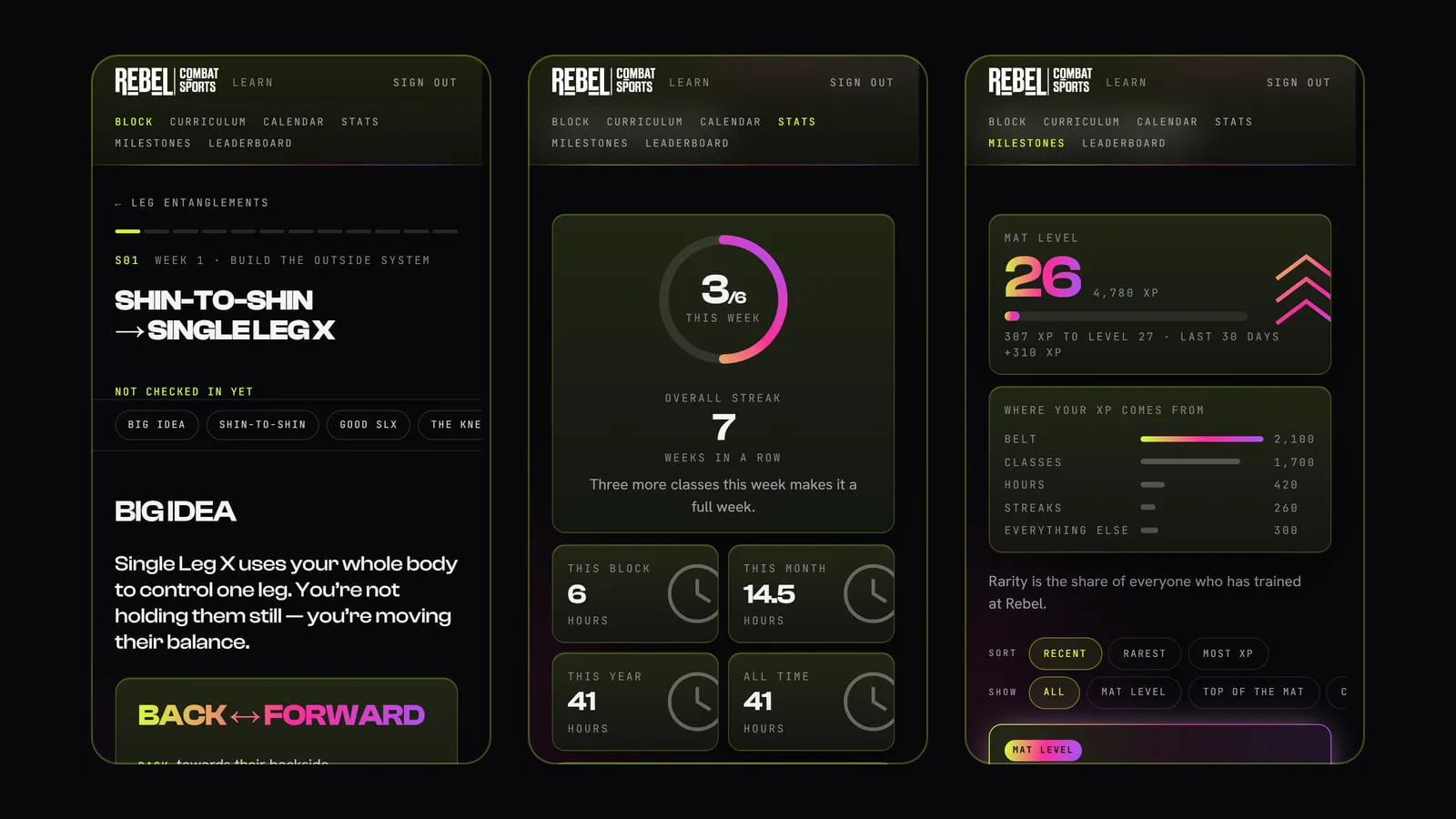
Every class comes with a study guide
What Learn, the members' side of this site, does for you between classes.

Most of what you’re shown in a grappling class is gone by the time you’re back in the car. You remember the shape of it and lose the details, and the details are the part that makes it work.
That’s hard on anyone. It’s hardest on two kinds of people: the new starter, who has nothing yet to hang the details on, and the person who trained somewhere before, drifted away, and is wondering whether it’ll go the same way again.
Learn is built for both. It’s the members’ side of this site and it comes with every membership. Below is what it does, problem by problem. The screenshots use sample members, not real ones.
”I’ve forgotten what we did on Monday”
So we write it down. Every no-gi session we teach has its own study guide, and it goes up after the class has been taught.
A guide opens with the one idea the session was built around. Then it goes through the steps in order, what a good version looks like, what to do when it stops working, how to defend it, what to practise and what to remember.
You can read it that night while it’s fresh, or weeks later when the position turns up in a round and you can’t remember the second step.
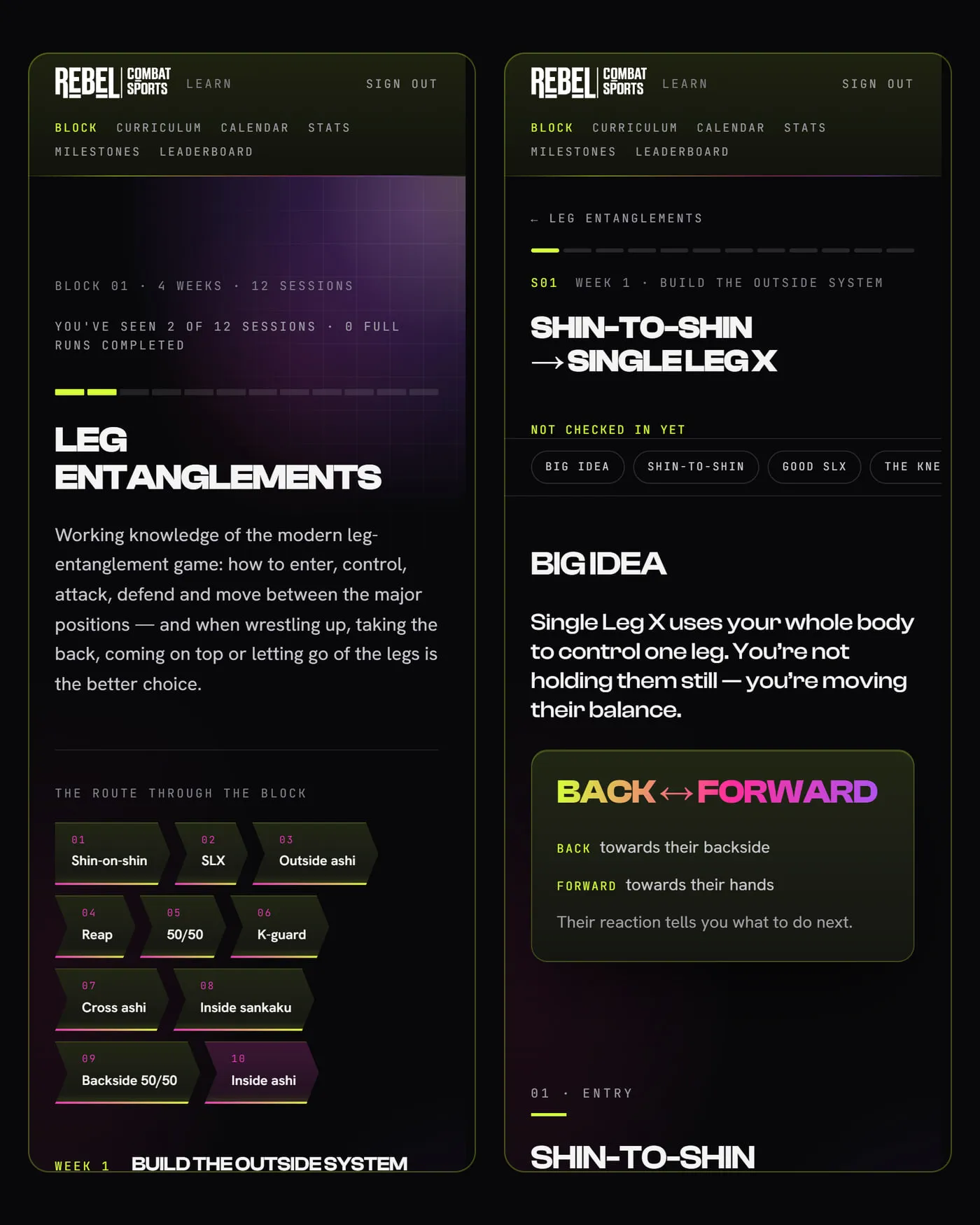
The written session guides cover the no-gi blocks for now. Gi classes are on the calendar and count towards everything else on this page.
”I missed a week and now I’m behind”
This is how a lot of people fall out of grappling. A holiday, a cold, a busy fortnight at work, and when you come back the class has moved on and you feel like the only one who doesn’t know what’s happening.
We train in blocks. Each block stays on one area of the game, so you get properly proficient at it before we move on, and each class feeds into the next. Learn shows you the whole route, so if you miss a class you can read what it covered before the next one. You walk back in knowing where the room is up to.
You can also see what’s coming. Nothing arrives out of nowhere.
”Everyone’s using words I don’t know”
Shin-to-shin. The reap. K-guard. Every sport has its own language and grappling has more than most. Nodding along when you don’t know the word is a normal part of being new, and it wears thin quickly.
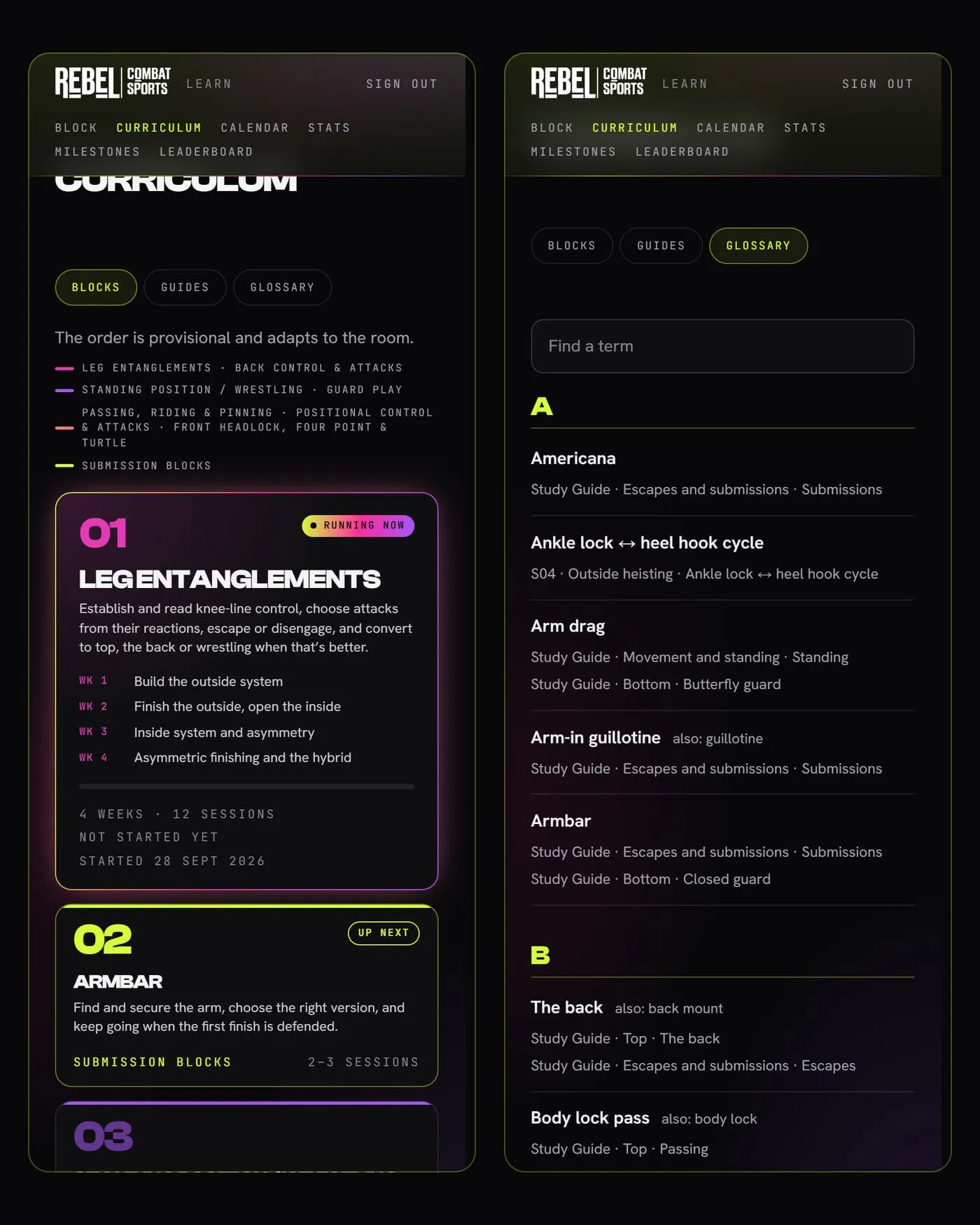
Learn has a glossary. Every term links to the session or guide where it’s taught, so you can look a word up afterwards and go straight to the place it’s explained.
“I can’t see how any of this fits together”
At a lot of gyms each class is its own thing. You turn up, you’re shown something, and next time it’s something unrelated. After six months you know a pile of moves and can’t say how they connect.
Learn lays out the curriculum: every block we plan to teach, in order, with what each one is for. The order adapts to the room, and the page says so.
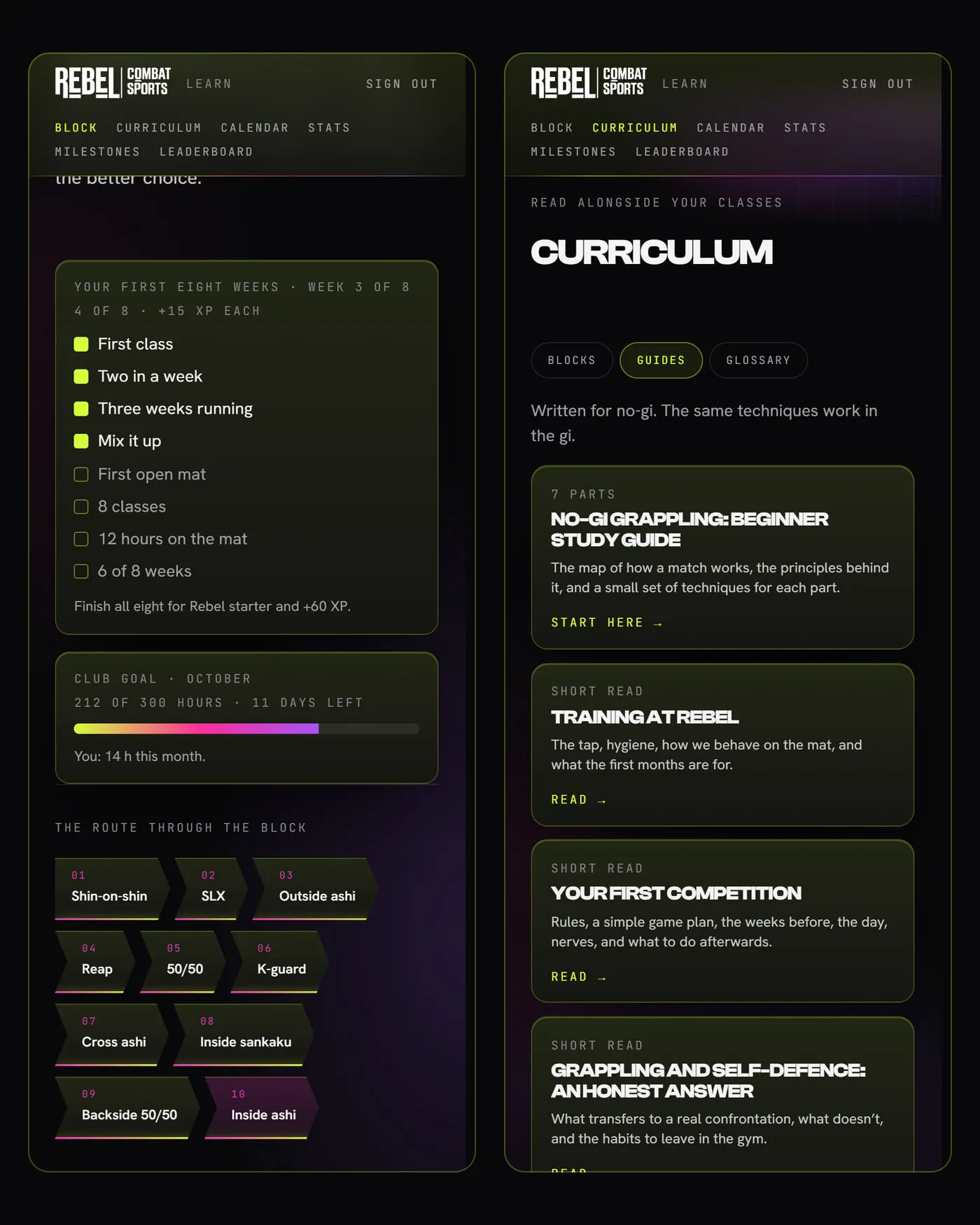
Alongside it are guides for the things a class rarely has time for. One is a beginner’s study guide that explains how a match works and the principles behind it. Others cover how we behave on the mat and what your first months are for, how to approach a first competition, and an honest answer on grappling and self-defence.
“I can’t tell if I’m getting anywhere”
Getting good at grappling is slow, and for a long time it doesn’t feel like progress. In many gyms the only marker you can see is a belt, and belts are years apart. That is a long time to keep turning up on faith.
Learn gives you nearer markers. You check yourself in when you’ve trained, and it keeps your hours on the mat, how much of the week you made, and how many weeks in a row you’ve trained.
New members get a short list for their first weeks: a first class, a second in the same week, a first open mat, and so on. Each one ticks itself off. It gives you something small to aim at while everything else still feels new.
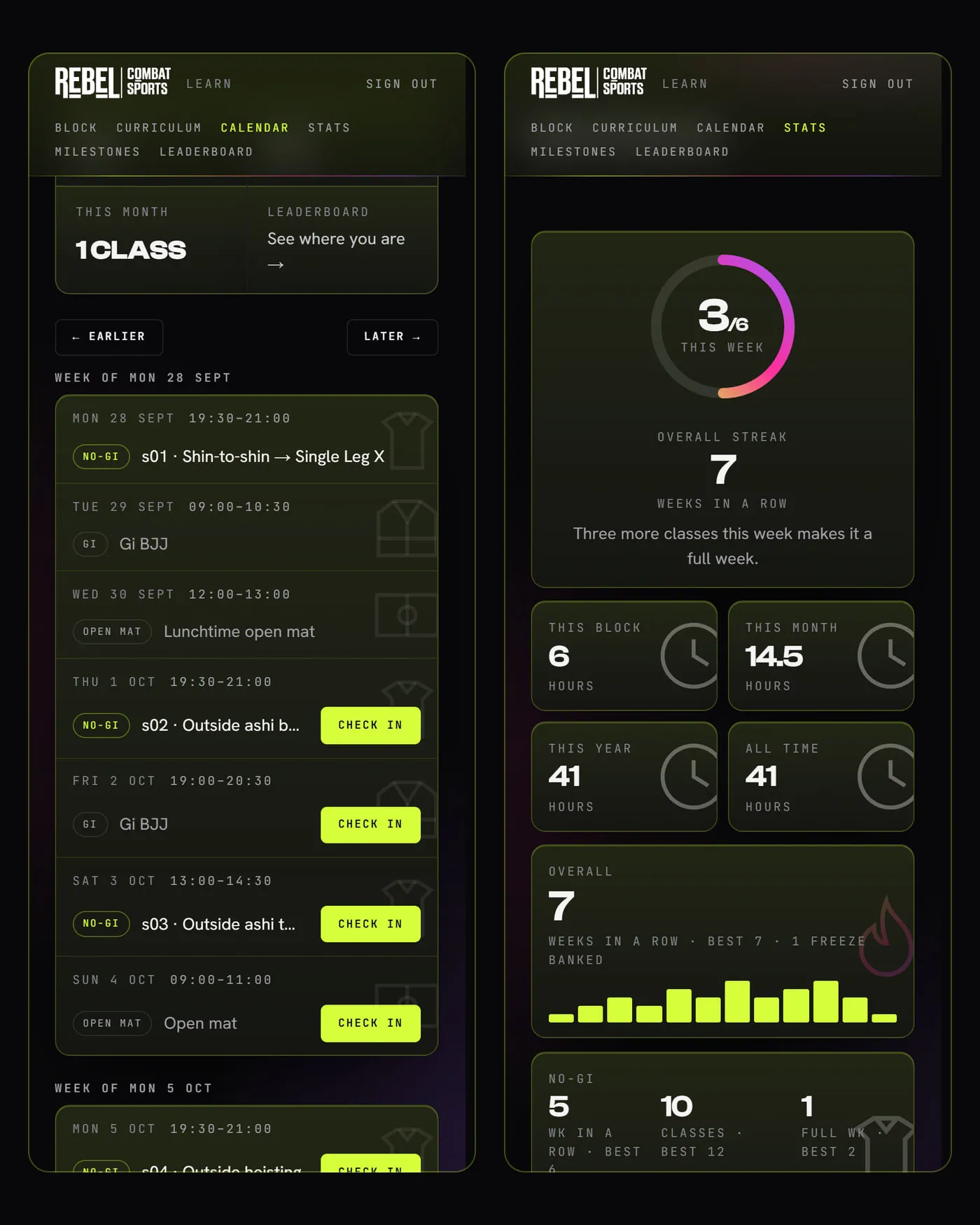
None of this measures how good you are at grappling. Rounds do that. It measures whether you turned up, and turning up is the part you control.
”Life got in the way and I never went back”
One missed week turns into three, and by then going back feels like starting again. Plenty of people who stop training never decided to stop.
Streaks in Learn are forgiving on purpose. Train consistently and you bank a freeze, and a freeze covers a week you miss. One bad week doesn’t wipe out months of turning up, and you have a reason to come back the week after.
The calendar helps too. It shows every session for the weeks ahead, with the topic of each no-gi class, so you can plan around the ones you least want to miss.
And it’s fun
Training earns XP, and XP sets your mat level. You earn milestones along the way, and each one shows how rare it is among everyone who has trained at Rebel. Competition results go in too, once a coach has confirmed them.
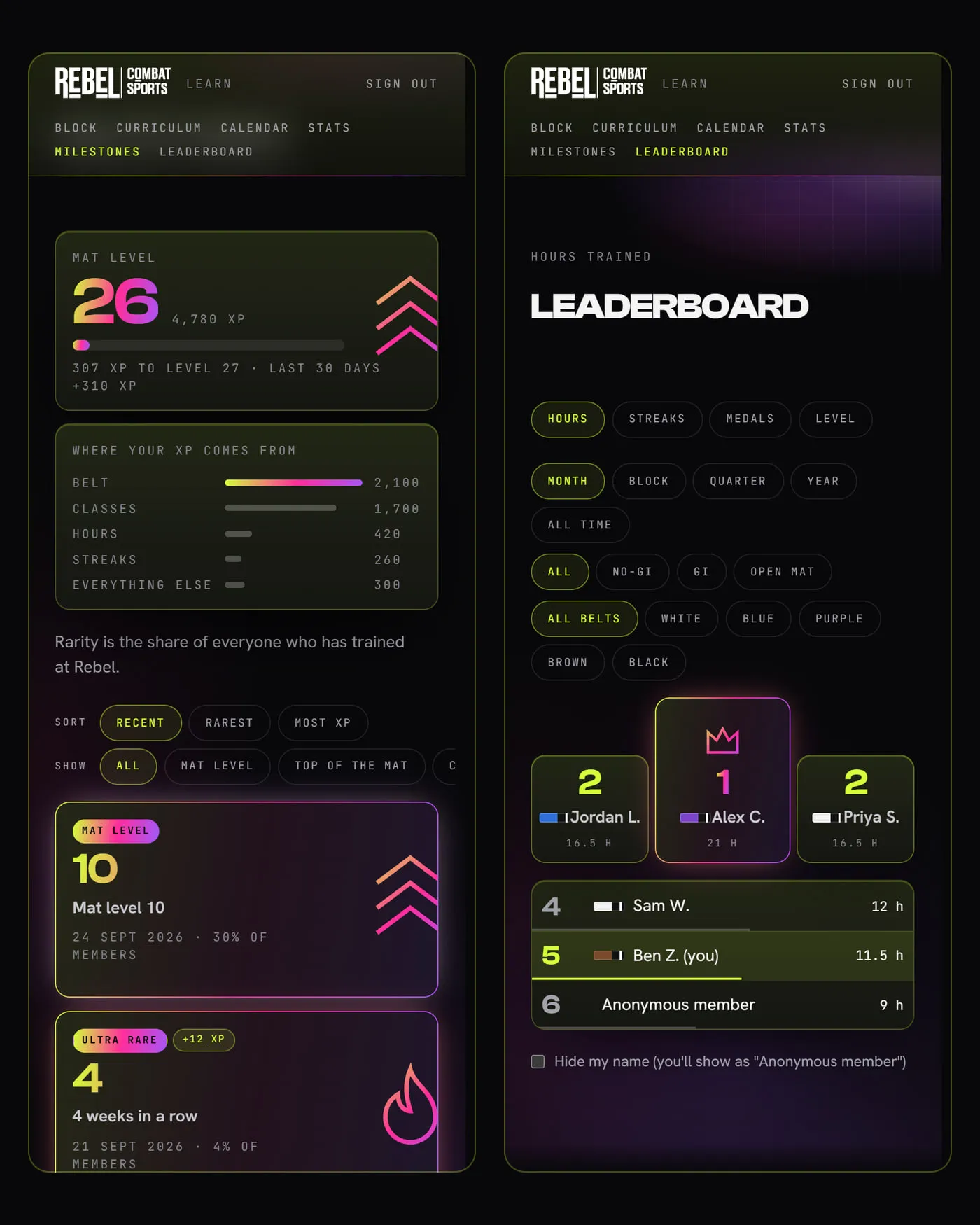
There are leaderboards for hours, streaks, medals and level, and a monthly goal the whole club works towards together. Because they count attendance and not ability, a beginner can top one in their first month.
If you’d rather not appear, one tick box shows you as “Anonymous member” everywhere.
How you get in
Learn is for members. When you join, we invite you by email, and you sign in with a code sent to that address. There is no password to remember and no app to install.
It’s included in both memberships at no extra cost. You can see those on the schedule and pricing page, and the first two weeks of training are free if you’d like to try a class first.