Stop waiting for the next technique
How to make the most of every training session at Rebel Combat Sports

There’s a moment in every class where the coach shows a technique, everyone pairs off, and within four minutes half the room has decided they’ve “got it” and is standing around chatting about the weekend.
You have not got it.
Nobody in the room has got it.
Some of the best grapplers alive haven’t got it. That’s why they still drill.
Here’s how to actually use the time.
Start slow. Fail. Keep going.
After you’ve been shown what to do, start as slowly as you need to.
Grease the groove of the movement, the drill, the position. Let your body find the shape of it.
You’re going to do it wrong. Several times. Before you’ve even worked out what question to ask the coach.
Good.
That’s the process working, not the process failing. If it were easy, you’d already know it, and we wouldn’t be teaching it.
Don’t rush to put your hand up after the first fumble. Wrestle with it a bit first. The confusion is where the learning lives.
The time to ask for help is when you can’t identify why it’s failing, not merely that it failed.
“It’s not working” is a rep.
“My grip keeps slipping and I don’t know what I’m doing wrong” is a question worth asking.
Start slowly enough to understand the movement. Make mistakes. Solve what you can. Ask better questions.
Then start turning the dials.
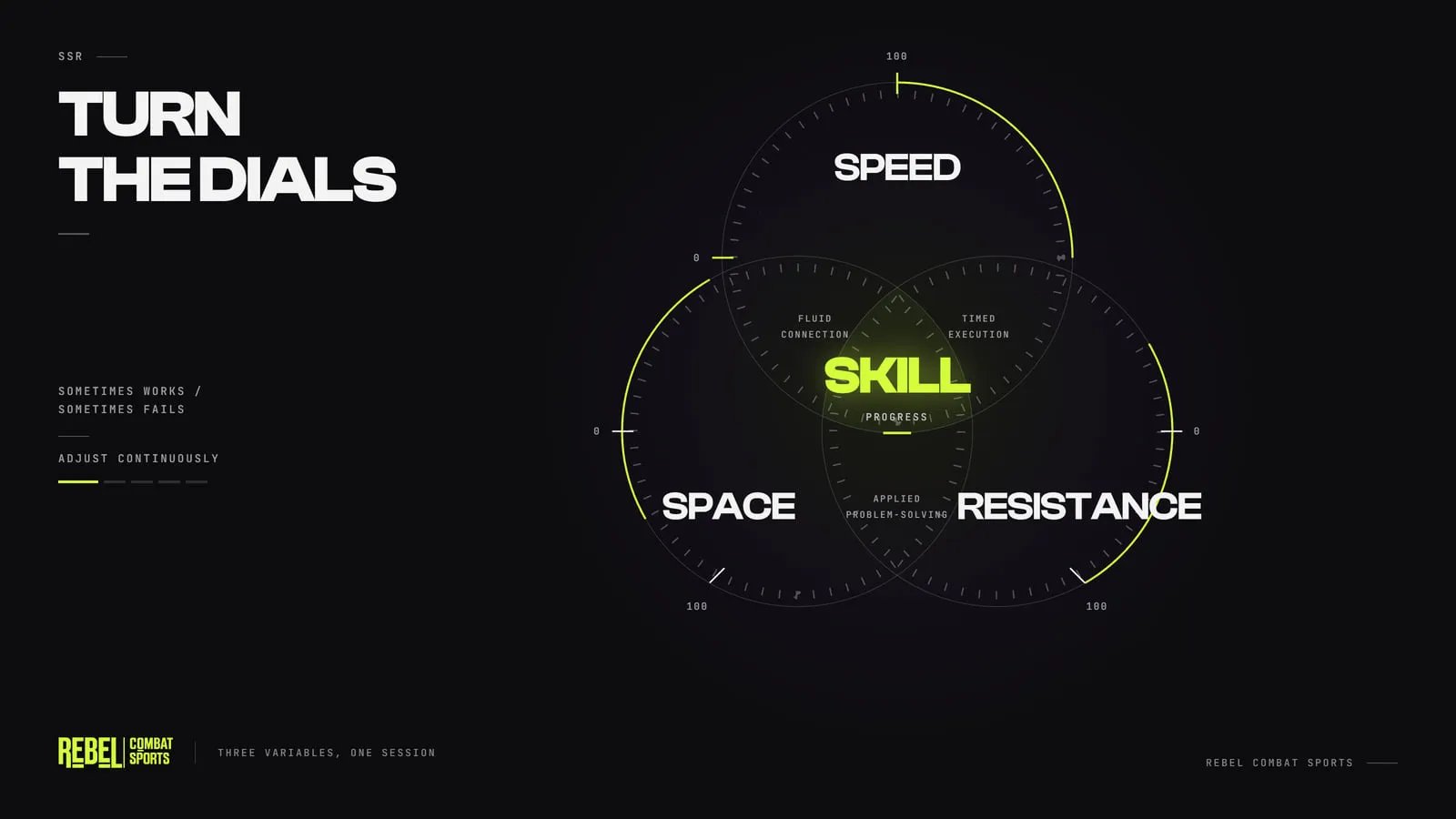
At Rebel, we use three:
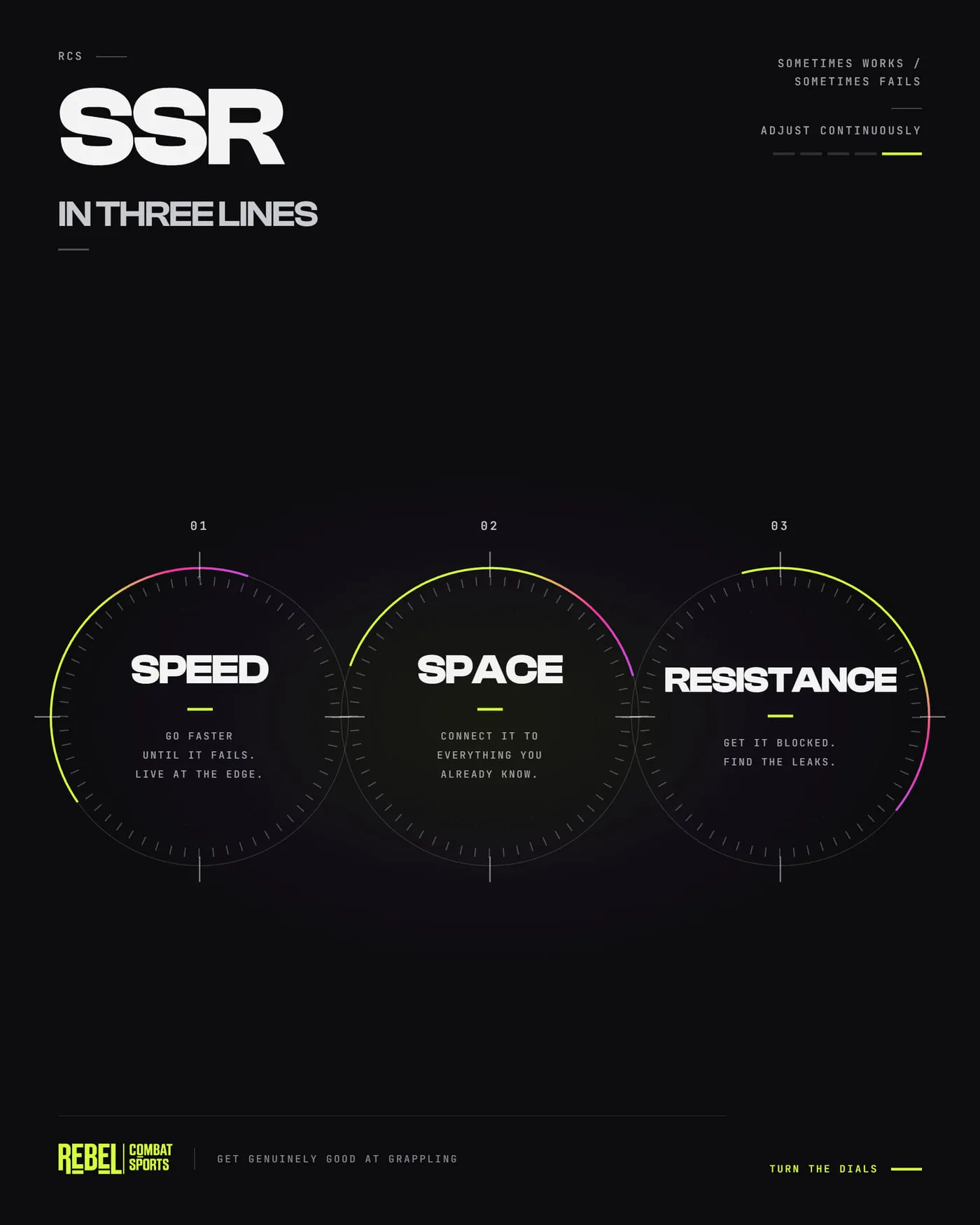
Speed. Space. Resistance. SSR.
They’re dials, not stages. You’ll turn each of them up and down throughout the session, and eventually throughout every round you ever roll.
Dial one: Speed
As you get confident, increase the speed of the repetition until you fail.
Stay at that speed until you can do it again. Then push further.
This isn’t recklessness. You’re deliberately increasing the difficulty so the movement has to survive tighter timing, greater variation and less time to think.
Going faster introduces more opportunities to fail more quickly, and more failure means more information. More variation. More divergence. More chances for your body to discover what works under time pressure.
Slow, perfect reps all session feel productive, but they’re only rehearsing the version of the technique that exists in a world with no opponent and no clock.
The self-regulation rule is simple:
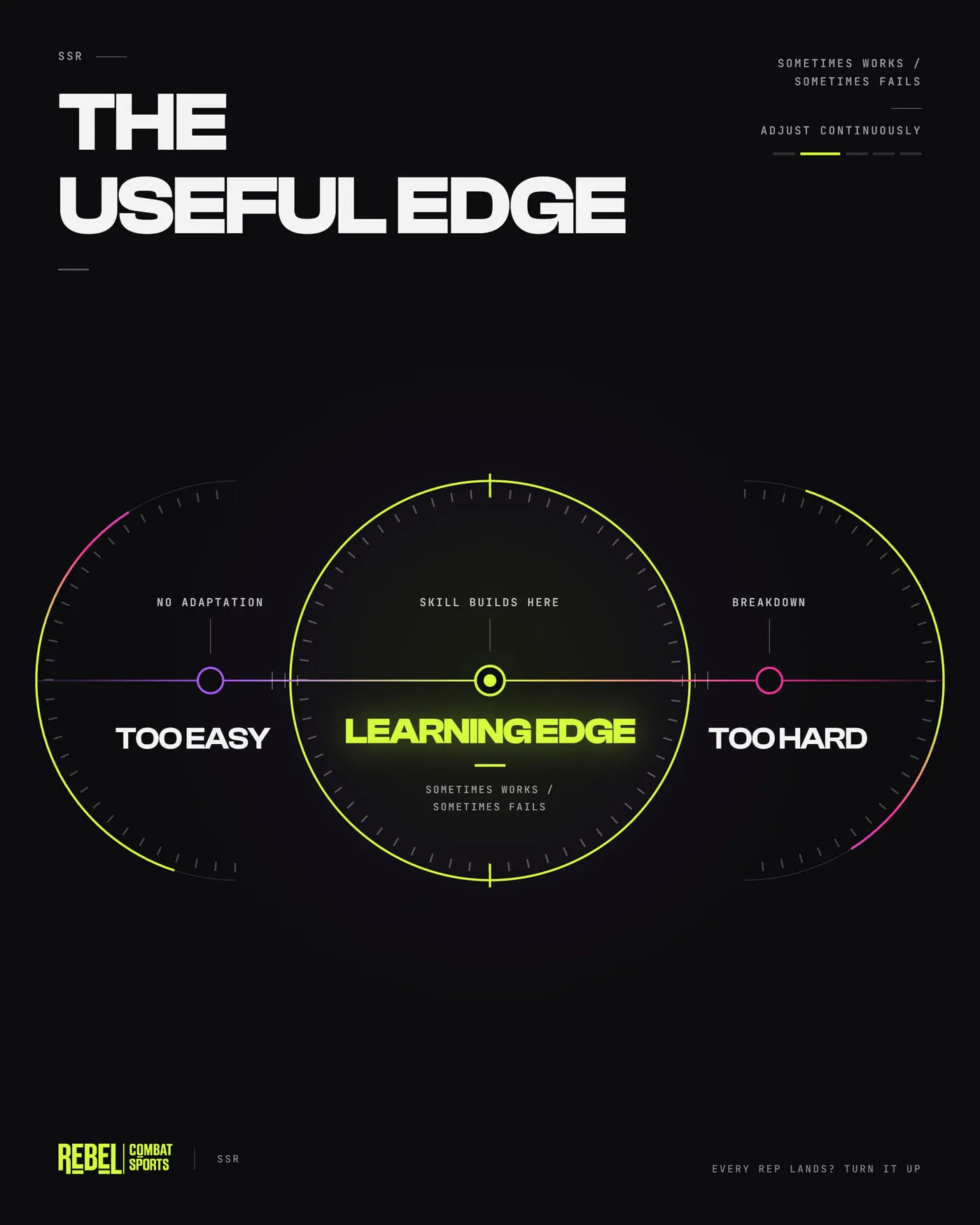
If you’re failing every single rep, dial the speed back one notch.
If you’re succeeding every single rep, dial it up.
You want to live at the edge where it sometimes works and sometimes doesn’t.
That edge is where skill gets built.
And to be clear, fast doesn’t mean sloppy or careless. The movement stays the movement. Your partner’s safety sets the ceiling.
If speed turns your technique into flailing, you’ve overshot. Come back a notch.
Failure at speed is not failure. It’s the fastest feedback loop in the room.
Dial two: Space
If you’ve pushed the speed as far as it’ll go, start exploring the space around the technique.
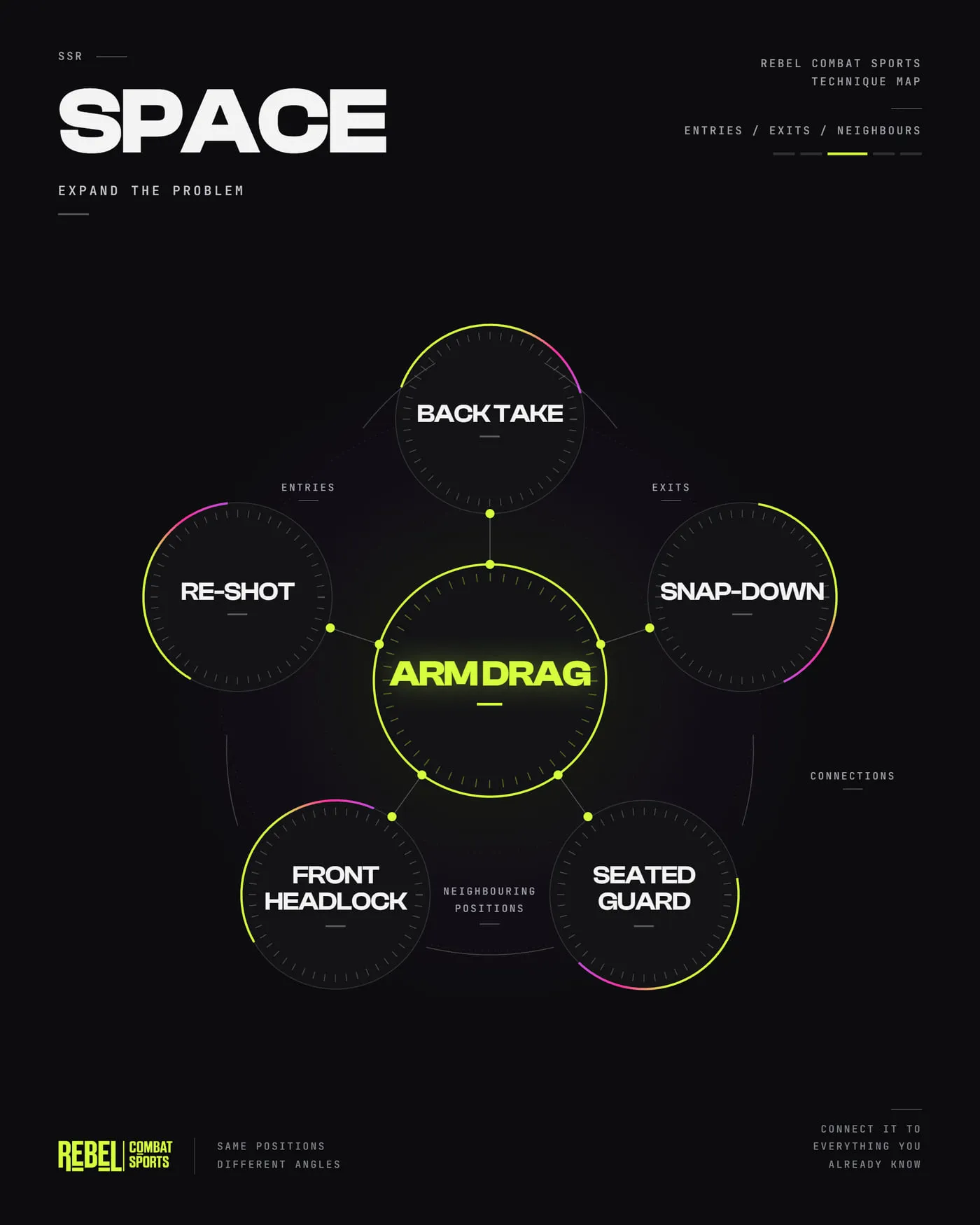
Space means expanding the problem around the movement: its entries, exits, neighbouring positions, related attacks and connections to the rest of your grappling.
How does it fit into what you already know?
Where do other movements cross over?
What happens if you enter it from a different position, or exit into one?
Be creative.
This is where techniques stop being isolated party tricks and start integrating into your actual game.
A move you can only hit from the exact setup the coach demonstrated isn’t a skill yet. It’s a recital.
Connecting it to the rest of your knowledge is what makes it yours.
Dial three: Resistance
Once you’ve gone fast and explored the connections, ask your partner to slowly ramp up resistance and start blocking your attempts.
This is your pressure test.
Resistance exposes the leaks in your movement and positioning that compliant drilling politely hides.
Every block your partner lands is a hole in your game you now know about, which puts you ahead of everyone who found out about theirs in a competition.
Ramp it gradually.
The point isn’t to sprint straight to full sparring. It’s the same edge as the speed dial. Keep the technique right where it sometimes works and sometimes doesn’t.
SSR in practice: the arm drag
Say the technique of the day is an arm drag.
Slow first. Grip, pull, angle, step. Fumble it a few times. Work out which part keeps going wrong before you ask about it.
Speed. Turn it up until the drag breaks down. Maybe your grip slips. Maybe your angle disappears. Stay at that speed until it lands again, then push on.
Space. Explore. Where does the arm drag connect to what you already have? It links into your snap-downs, feeds your back takes, shows up from seated guard. Try the entries. Follow the exits.
Resistance. Now your partner starts pulling the arm back, squaring up and fighting the grip. Suddenly you find out whether your drag survives contact with someone who doesn’t want to be dragged.
Twenty minutes, one technique, four different training environments.
That’s a session doing real work.
Being a good partner
Resisting isn’t a favour you grudgingly grant. It’s training for you too.
Every attempt you block is a rep of defensive reading: feeling the setup coming, recognising the grip, answering it.
Both people are working.
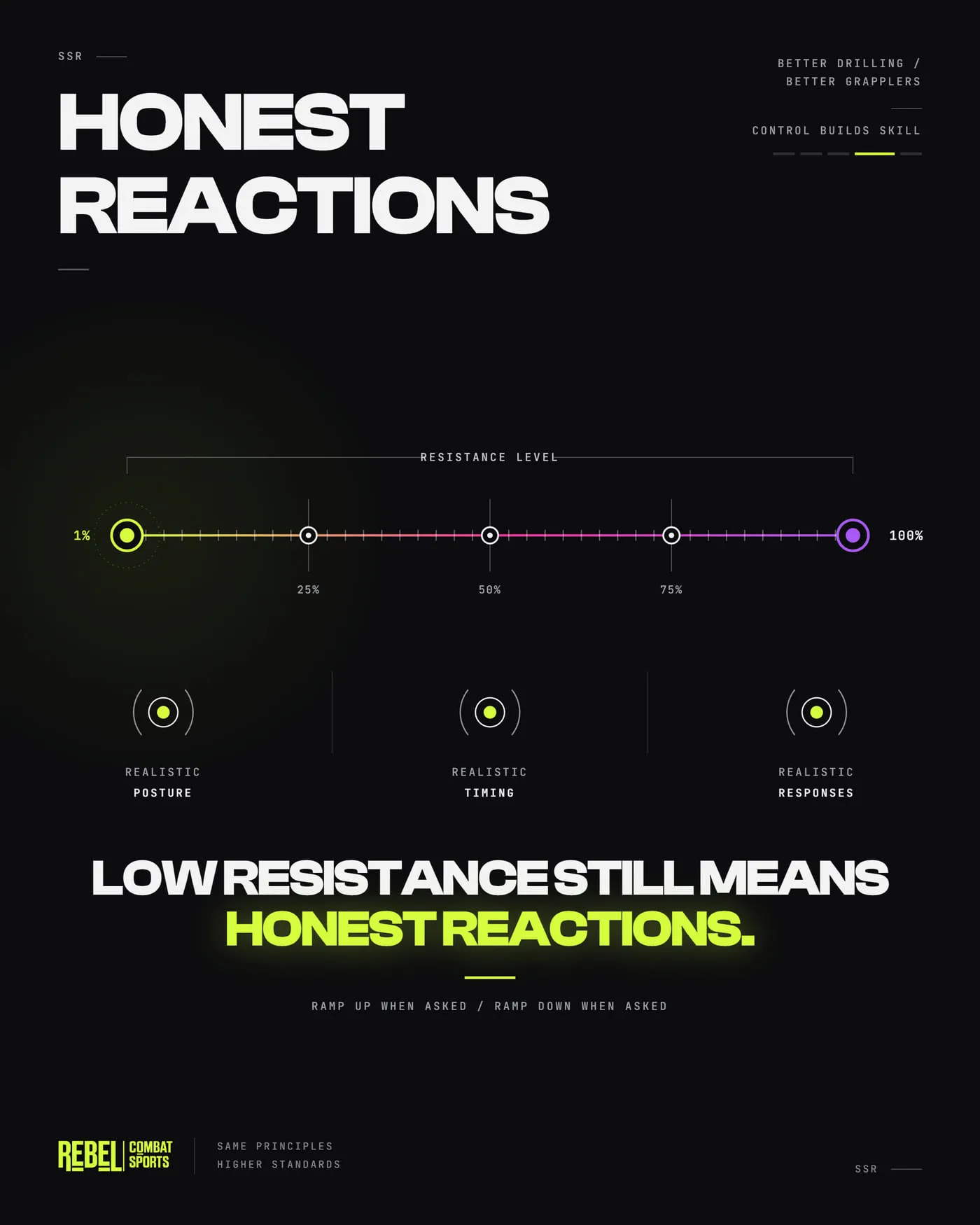
And here’s the other half of the deal: a good partner maintains a realistic reaction even at 1% resistance.
Flopping about, positioning lazily, standing in postures no live opponent would ever hold. That’s not “being easy to drill on”. It’s wasting your partner’s time.
Low resistance still means honest reactions.
Your partner is rehearsing against a human being, so give them one.
Ramp up when asked, ramp down when asked, and react like a grappler at every level in between.
Eventually, you stop thinking about the dials
The best grapplers run SSR intuitively, all the time, without being told.
They turn the dials up and down inside every drill and every round.
That’s a soft skill, and like any skill it can be trained.
Do it deliberately and it becomes automatic.
Develop it and you will massively increase the rate at which your grappling improves, not because you’re training more hours, but because every hour is doing more work.
This, by the way, is why you won’t find endless dead-pattern drilling at Rebel Combat Sports.
Reps against nothing teach you to beat nothing.
We’d rather you spend your mat time at the edge where learning actually happens.
The coach’s pet peeve
Don’t just sit around.
If you think you’ve mastered the movement or the position, turn a dial anyway. Unlikely, by the way. You’ve got a whole lifetime for that.
- Speed: ramp it up and break it.
- Space: explore its connections into everything else you’ve practised.
- Resistance: ask your partner to fight back and block your attempts.
Standing still isn’t rest.
It’s just standing still.
SSR, in three lines
- Speed: go faster until it fails. Live at the edge.
- Space: connect it to everything you already know.
- Resistance: get it blocked. Find the leaks.