
Generated illustrations of a fictional gym — no real club or person is depicted
What doesn't belong in a grappling gym
Five things that don't belong in a grappling gym, from circuit training in a coached class to rank that depends on favours, and five things you should expect instead. Run the tally on any club, including ours.

There are gyms where your next stripe depends on leaving a five-star Google review. Not on whether you can pass a guard, or hold a position against someone who doesn’t want you there. On whether you’ve done the coach a favour.

A belt is supposed to be a measurement. It tells you roughly where your skill sits, and it’s worth something for exactly as long as it’s accurate. That’s it. That’s the job. The moment it stops being a measurement and becomes a currency the coach controls — something you earn by being liked, being loyal, being useful — everything downstream of it gets strange. People stop asking questions. People stop training elsewhere. People start doing unpaid favours for a piece of fabric.
I’ve written about my own version of that and I won’t do it again here. What I want to put down instead is the wider list: what I think doesn’t belong in a grappling gym, and what you should expect instead. Not as a comparison to anyone in particular. As the standard we hold ourselves to at Rebel Combat Sports, which you’re welcome to hold us to as well.
Five things that don’t belong in a grappling gym
1. Thirty minutes of circuit training
You are paying for tuition. Mat time with a coach is the most expensive and scarcest thing you buy. You can get fit anywhere — Adrian owns a gym and still says take the mat — but you cannot learn to fight for an underhook anywhere. There is nothing about a burpee that requires a coach, a training partner, or a mat, so spending a third of the lesson on shuttle runs is spending your money on the one thing you could have got for free.
I’ll be blunt about why it happens: conditioning fills the hour without requiring a lesson plan. It looks like effort. Everyone leaves sweating and feels like they did something. It’s the easiest possible way to run a class badly and get away with it.
Someone will say that hard positional rounds are conditioning too, so where’s the line? Skill content. Working a position while exhausted is still working the position — fatigue is a constraint on the problem. Star jumps are not a position. Warm up properly, then spend the rest of the hour doing the thing you came for.
2. Long contracts you can’t get out of
It is fine to change your mind. People get injured, have babies, change jobs, move away, or just work out that grappling isn’t for them. None of that is a betrayal and none of it should cost hundreds of pounds to escape.
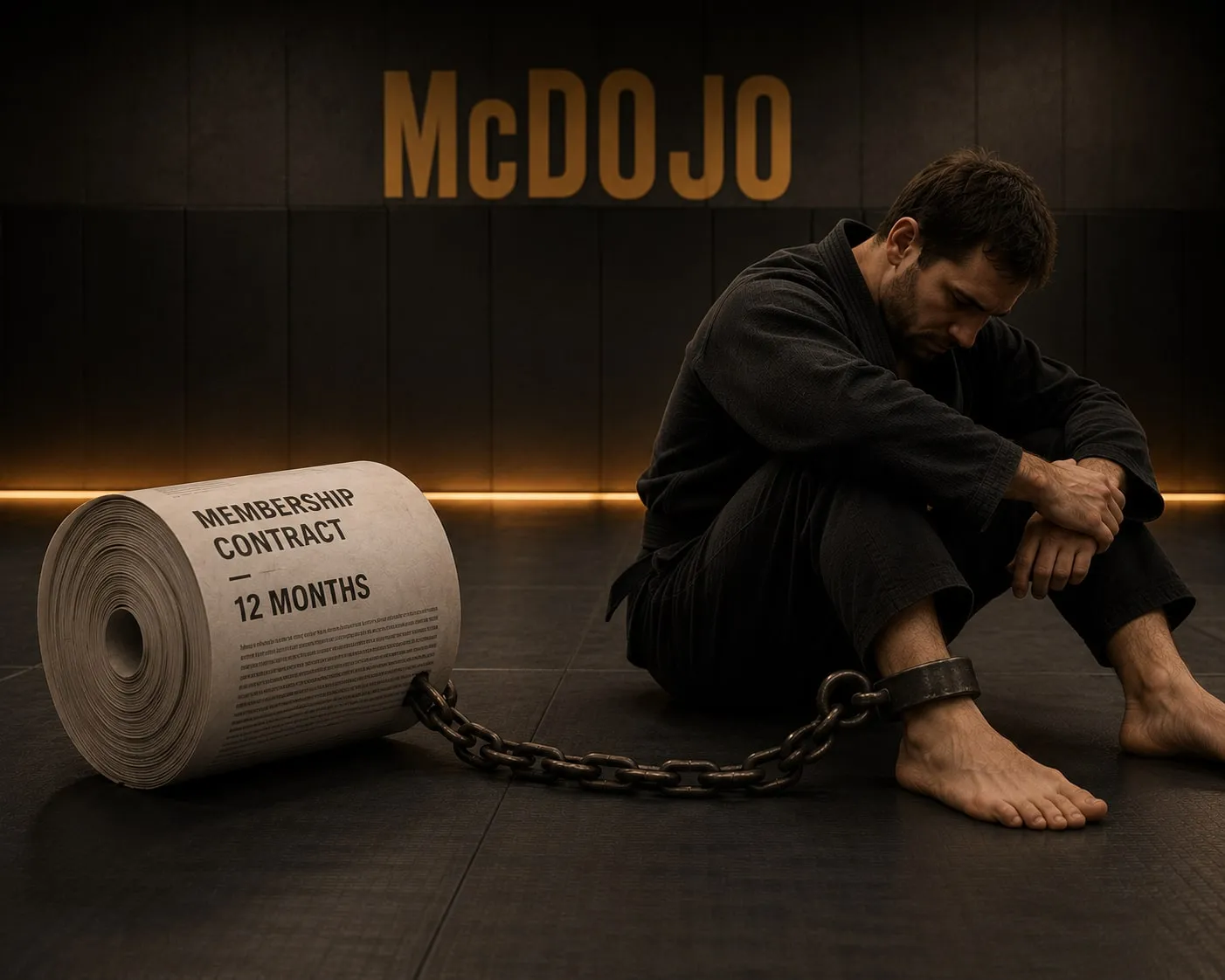
A reasonable notice period is fine — clubs have costs and need to plan. Twelve months with no early exit and no refund is not a notice period, it’s a trap. And if the main thing keeping people in a club is a direct debit they can’t cancel, that club has a product problem it’s solving with paperwork.
We don’t run a notice period at all: cancel any time, nothing beyond the current month. That isn’t generosity, it’s the incentive pointed the right way round. Make the training good enough that people stay because they want to.
3. Being punished for training somewhere else
Frosty treatment, quiet exclusion, suddenly not getting corrections, jokes that aren’t jokes — all because you went to an open mat at another gym, or took a seminar with someone your coach doesn’t like.
This one only makes sense if rank is loyalty-coded rather than skill-coded. If a belt marks what you can do, then rolling with more people can only ever help, and you coming back sharper is the entire point of the exercise. If a belt marks whose side you’re on, then cross-training looks like treason.
A coach who feels threatened by you training elsewhere is telling you something about their own confidence. It isn’t about your character. Our Sunday open mat is free and open to anyone, including people who train somewhere else, which is the same position stated as a practice rather than an opinion.
4. Favours in exchange for promotion
The Google review. Filming content for free. Cleaning up. Being available. Endless small unpaid contributions with a stripe dangled at the end of them.
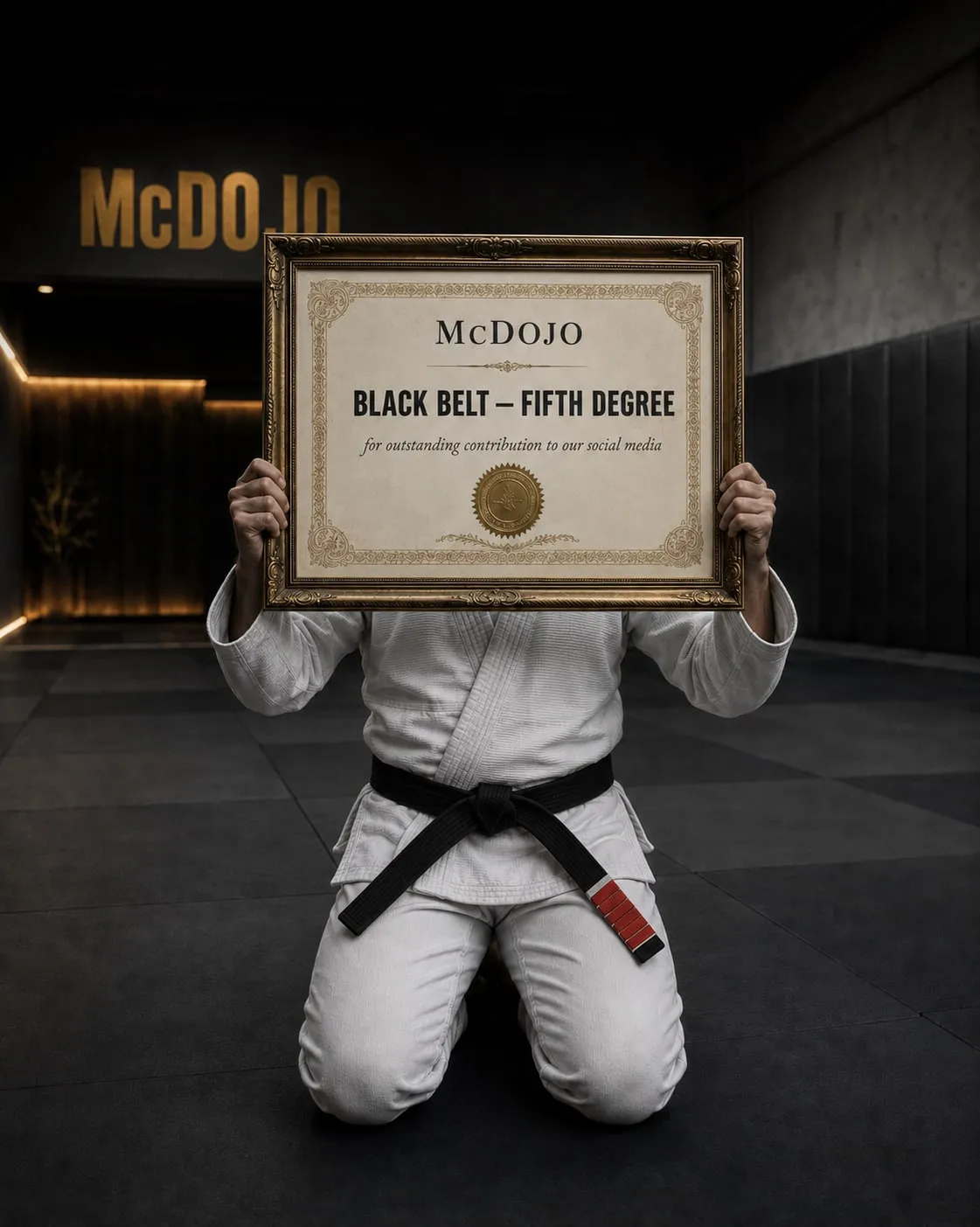
Once rank can be bought with services, it stops measuring anything. And it puts every honest person in the room in an impossible position, because now they can’t tell whether the person in front of them is good or just useful.
That’s the unpaid version. There’s a cash version too — the grading fee, the association fee, the branded gi you can only buy from the club. A charge that covers a certificate and some admin is one thing. A fee that scales with the colour of the belt is a price list, and a price list is not an assessment. We don’t charge for gradings here, and we never will.
Your grading should be able to survive you never doing the club a single favour.
5. Everybody who left is a traitor
Listen to how a club talks about people who aren’t there any more. The ones who moved to another gym, the ones who stopped training, the coach who went off and opened his own place.
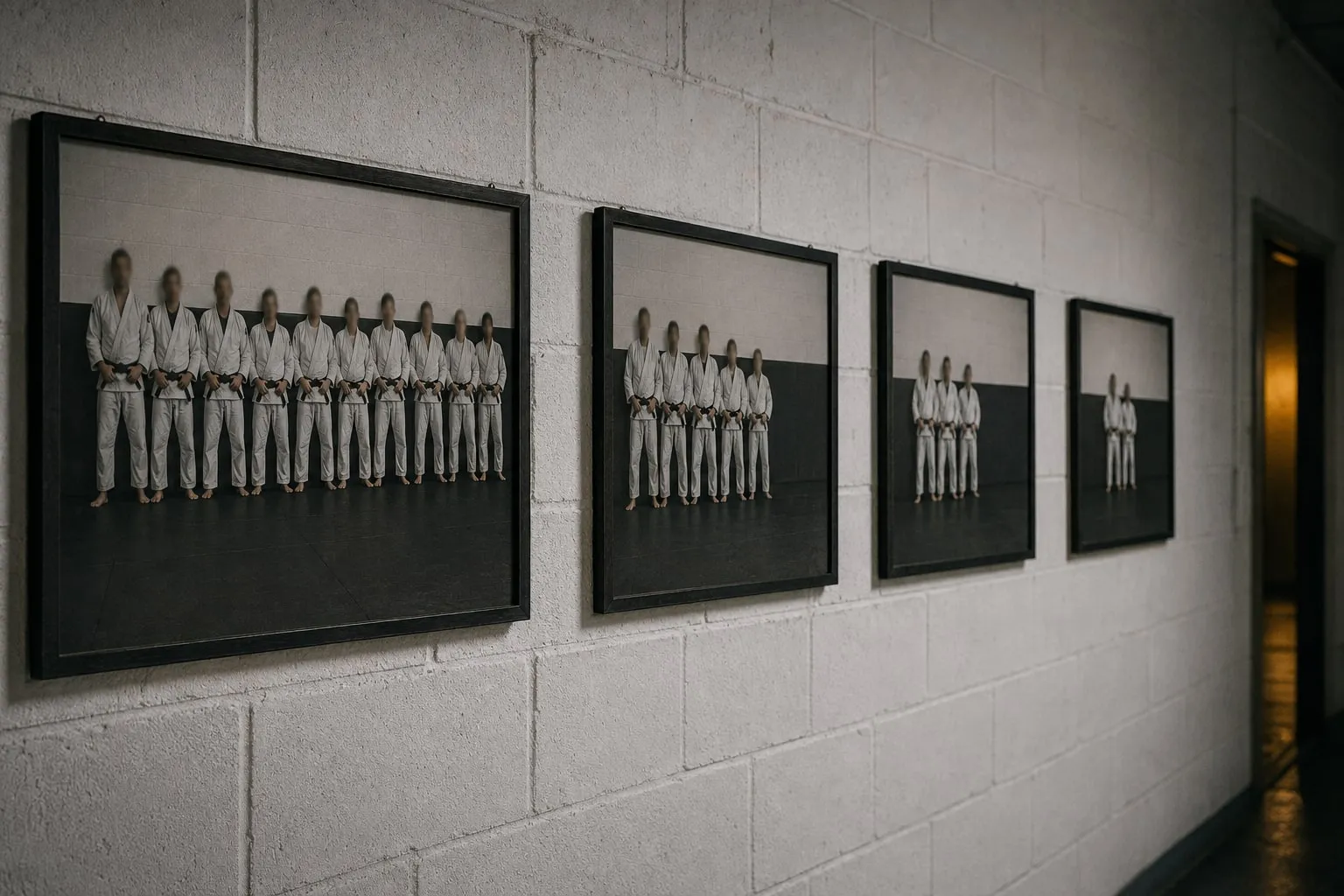
If the story is always the same story — they were disloyal, they were ungrateful, they took what they needed and left — then you’re not being told about them. You’re being told about you.
Because notice what’s missing. Nobody ever left because they had a baby, or moved for work, or couldn’t afford it any more, or simply decided it wasn’t for them. Nobody ever left because the club wasn’t good enough for them, which happens all the time and is nobody’s moral failing. When one explanation covers every single departure, it isn’t an explanation. It’s a policy, and its purpose is to make sure nobody in the room ever looks too hard at why people keep going.
It comes bundled with the same reflex pointed outward — the running commentary about how every other club within thirty miles is a fraud, a McDojo, or dangerous. Same machinery. Everyone outside this room is either an enemy or a traitor, so there’s no reason for you to go and find out what normal looks like.
And it’s why nobody in that room ever challenges anything. If walking away is treason, then asking a difficult question is just treason you haven’t committed yet.
People should be able to leave your gym and be spoken about generously the following week. That costs a coach nothing except the small discomfort of admitting somebody chose something else.
Five things you should expect instead
1. Safeguarding that happens while the round is still running
Policies matter, and there should be real ones — ours are published, and they matter more because we take some under-18s. But the live version of safeguarding isn’t a certificate on the wall. It’s a coach who notices that a 90kg bloke is using a beginner as a crash-test dummy and stops it in the moment, without the beginner having to complain.
Grappling carries risk and accidents happen to everyone. But if the injuries cluster around one person, that’s a pattern rather than bad luck, and spotting the pattern is the coach’s job. Someone who has to crank a submission on a beginner to make his point is someone who can’t make the point any other way — and a room full of people quietly protecting themselves is a room that has stopped learning.
Nobody should have to protect themselves from their own teammates.
2. Clean mats, and hygiene that’s actually enforced

Mats disinfected after every session. Kit washed after every session. Nails short. If you’ve got something on your skin, you cover it or you sit out, and nobody makes you feel awkward about saying so — that’s the culture working, not failing.
Ringworm and staph outbreaks are not bad luck. They’re a coaching failure. Someone let standards slide.
3. Coaching based on what works, in sessions that join up
A technique earns its place by working on a resisting person at roughly your level. Not because a world champion hit it in a final against another world champion, and not because it looked incredible on a phone screen. That’s most of what I mean when I say we coach this as a sport: every claim gets checked by someone actively trying to prove it wrong.
You should also be told why it works — the position, the mechanism, what holds it together. Steps alone leave you stranded the moment your partner does something slightly different. Understand the structure and you can rebuild the thing yourself when it breaks.
There’s a straightforward test for whether any of this is happening, and you can run it without knowing anything about grappling. Do the classes join up? If this week has nothing to do with last week, and next week will be something else again, that isn’t a varied syllabus. That’s usually a coach who watched something on Instagram on the drive in.
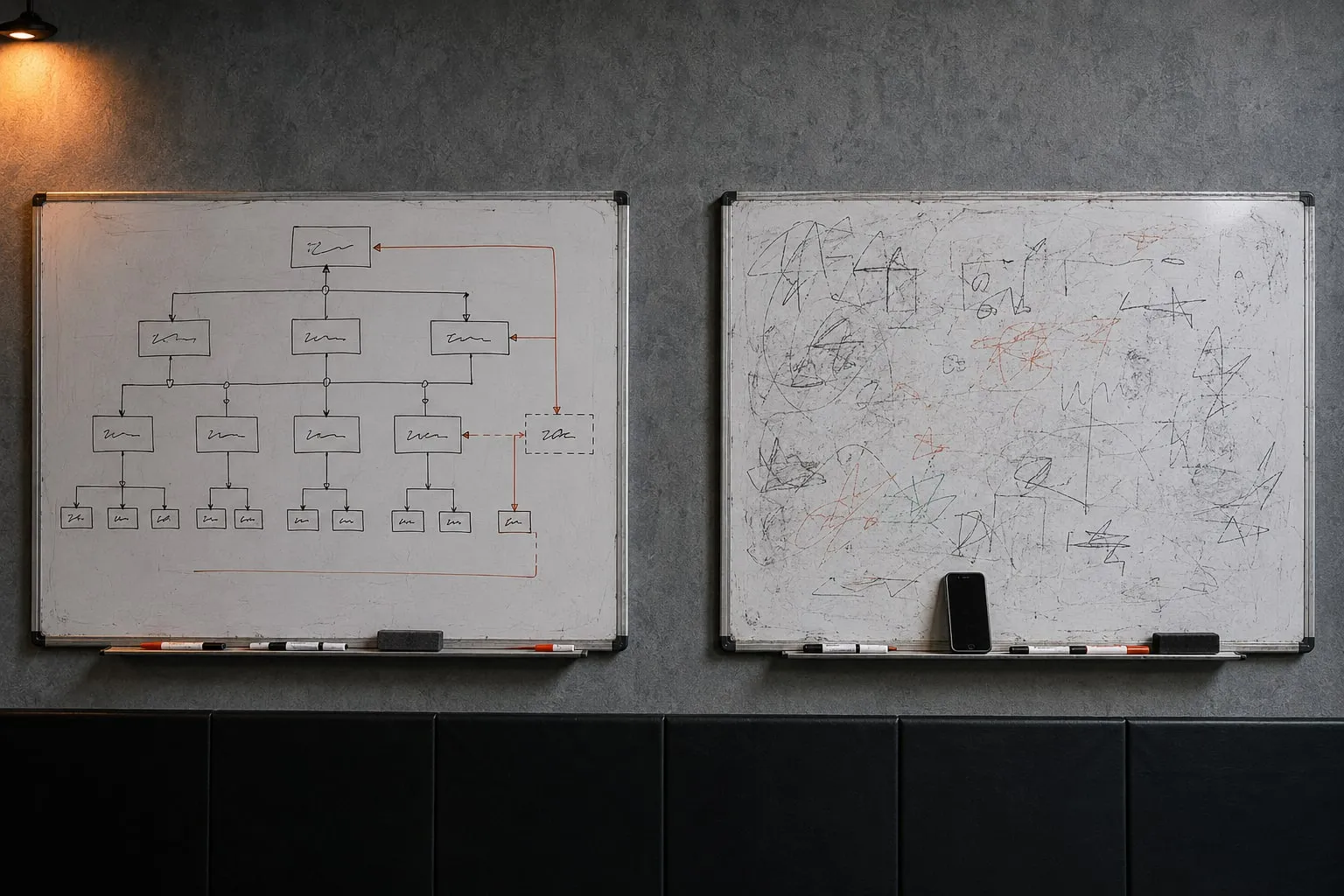
A curriculum builds. You should be able to feel this month’s work sitting on top of last month’s, and to tell roughly where the current block is heading. If every session is a fresh start you aren’t accumulating anything — you’re collecting moves you’ll never find under pressure. Planning also leaves a paper trail, which is why we published exactly what we covered in our first week. Structured coaching is an easy thing to claim and a hard thing to fake.
4. To be treated like a customer, and met where you actually are
There is no earning the right to be taught properly. You paid on day one, so you get real coaching on day one.
Which is also why nobody here does press-ups at the door for turning up late. You’re an adult who paid, missing part of the class is already the entire consequence, and a dressing-down in front of the room adds nothing except the pleasure of delivering it. Warm yourself up and slot in.
Being met where you are means the class adapts to the room in front of it — not sorting people into the ones worth investing in and the ones making up numbers, and not running a fixed plan at a room it doesn’t fit.
And if you want one thing to watch, watch which direction respect travels. If it only ever flows upward, the word isn’t being used to mean respect, it’s being used to mean obedience. The giveaway is how the newest, least skilled person in the room gets spoken to.
5. To be able to question the coach, out loud, in front of everyone
“I don’t know, let’s test it” is the strongest thing a coach can say. It’s also the only honest answer available a lot of the time.
There are two standard ways a question gets shut down: rank and mileage. Because I’m the coach, or I’ve been doing this twenty-five years. Neither is an answer to “why does this work?” — they’re both ways of ending the conversation without having it. Experience is genuinely valuable, but it’s valuable because of what it produced: the evidence, the answer, the tested thing. Not as a substitute for any of them. Time on the mat is worth exactly as much as what you did with it.
If a question can be shut down, the room learns to stop asking and the coach stops finding out where they’re wrong. Everyone gets worse, slowly, and nobody notices because it’s comfortable. A question isn’t a challenge to authority. It’s free information, and the whole room benefits from it.
Adding it up: is your gym a McDojo?
None of these on its own condemns a club. Everyone gets something wrong, and a coach who’s excellent on the mat can still be hopeless at admin. One item off the list is a conversation, not a verdict.

But it’s worth running as a tally. Count how many of the first five you recognise. Count how many of the second five you actually get. If the first number is bigger than the second, you are not in a demanding old-school gym with high standards.
You’re probably in a McDojo.

The difficult part is that it’s almost impossible to see from the inside, because every bit of it is presented to you as normal, and everyone training around you has already agreed to it.
We do award belts at Rebel Combat Sports, and we take the assessment behind them seriously. Belts here are earned against a written syllabus — performance criteria, not time served. Getting the measurement right matters, because a rank that doesn’t track ability is worthless to the person wearing it and misleading to everybody else.
But that is the entire scope of what it does.
Your belt should describe what you can do on the mat. It shouldn’t decide who’s allowed to ask a question on a Tuesday night.