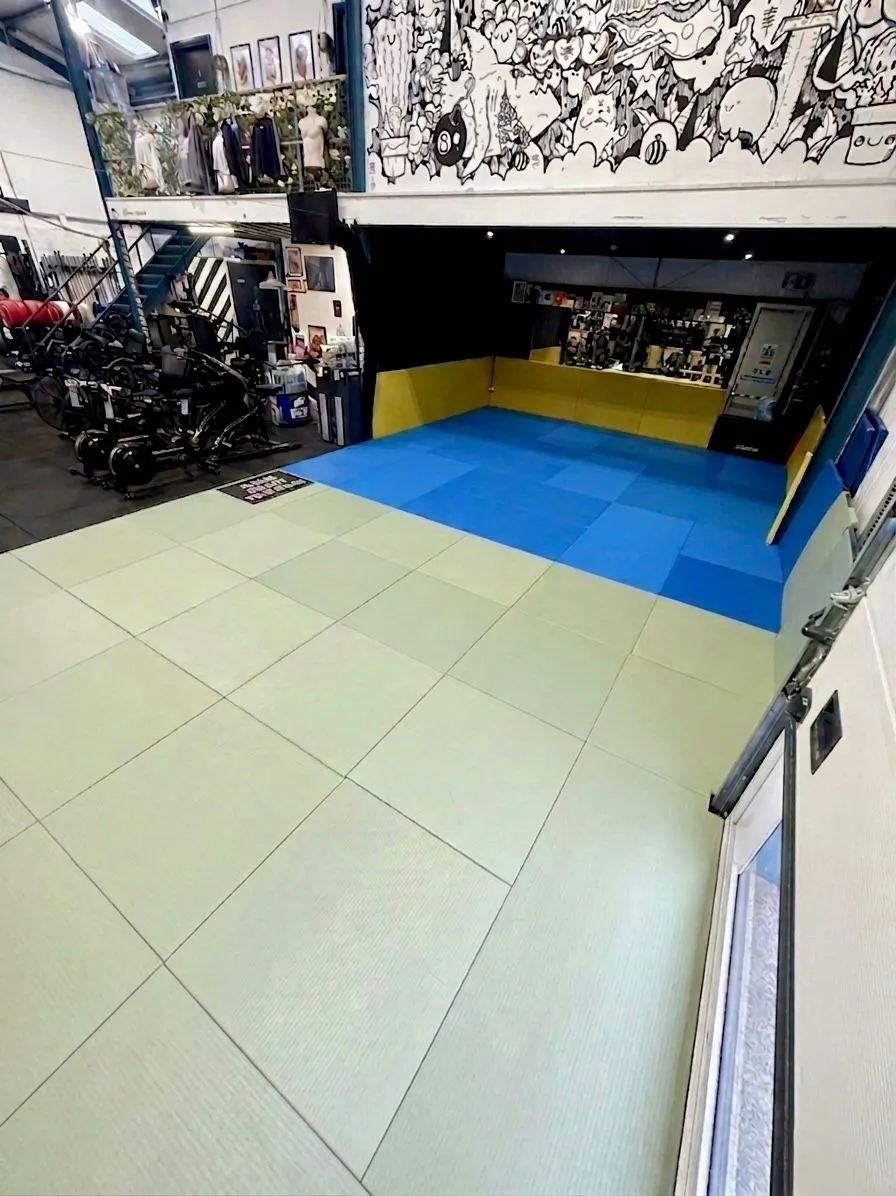
What your first session actually looks like

The hardest part of your first session happens before you ever get to the mat. It’s the drive over — not knowing anyone, not knowing what you’re walking into, half-expecting to be thrown straight to the wolves. That’s the bit that stops most people. So let me take it away: here is exactly what your first session looks like, start to finish. No surprises.
Before you get there
Wear shorts without pockets or zips — they catch fingers and toes — and a rash guard, or just a plain t-shirt for day one. Bring a mouthguard and some water. That’s the whole list. You don’t need any kit, and you don’t need to have done a single day of anything like this before. If you want the fuller version, it’s all here for beginners.
You don’t need to get in shape first
This is the one that stops people for months — the idea that you’ll start once you’ve got a bit fitter. Don’t wait. Nothing gets you ready for grappling except grappling; you get fit by doing it, not before it. You might be sore in places you didn’t know you had for a day or two afterwards — that’s just the sport using muscles nothing else touches, and it settles fast. Turning up exactly as you are today is the whole requirement.
Walking in
When you arrive, someone is expecting you. You’re not left hovering at the edge of the mat wondering where to stand. We’ll show you where to leave your shoes, where to go, and who you’re training with. Then you join in — wearing the same thing as everyone else, doing the same thing as everyone else. Nothing marks you out as new except the fact that you’re new, and every single person in that room has been exactly that.
The shape of the hour
Every session has a focus and a shape, and it’s the same shape on your first night as on your hundredth. We warm up with movements built for what we’re doing that day — not punishment, just getting your body ready. Then we play constraints-led games: small, structured problems that get you moving like a grappler without needing you to memorise anything first. You’ll get individual feedback on what you were just doing, and a little group feedback on what the whole room can work on. Then live rounds. Then a cool-down where you can ask anything. That’s how we train, every time.
The important thing to understand is that you are coached through all of it. Nobody stands you in front of the class to perform. Nobody expects you to know a single technique walking in.
You’re not walking into a test. You’re walking into a class where the whole room’s job is to make the next person better.
The rolling — the part everyone worries about
Live rounds are what people are most nervous about, so let me be straight about them. You will not be fed to the biggest, most experienced person in the room to see what happens. Rounds are calibrated to you — beginners start carefully, and you’re paired with intention, not at random. Your partner isn’t trying to hurt you or to prove something at your expense.
Your only job in your first rounds is to stay calm and keep breathing. Not to win, not to tap anyone, not to look good — just to be there and pay attention. Nearly everyone does the same thing at first: they tense every muscle, hold their breath, and run out of gas in about ninety seconds. When that happens it isn’t your fitness failing — it’s nerves, and it goes as soon as you learn to relax and breathe through it.
Your first rounds aren’t a fight to win. They’re a problem to stay calm inside.
And you tap early and often. The tap is the safety valve, and you use it freely — there’s no ego in it. The people who get hurt in grappling are the ones too proud to tap, not the ones who tap the moment they’re caught. Being “smashed” on your first night isn’t the point and won’t happen the way you’re picturing it. You leave having actually grappled, safely, and knowing you can come back and do it again.
When it’s over
We finish with a cool-down and questions, and nothing is off-limits. Ask about what happened, what didn’t, what to work on before next time. The questions you think are stupid are almost always the ones everyone else in the room had on their first night too.
That’s the whole thing. One hour, a clear shape, coached the entire way through, with people whose job that night is partly to look after you. The nerves on the drive over are real — but they’re about the unknown, and now it isn’t one.
The first two weeks are free, no card and no commitment. Book a trial and come and find out that the hardest part really was the drive over.