Coached as a sport.
Martial arts taught without the mysticism — by treating grappling as the sport it is. Modernism over tradition. Progress over styles. Skill over ranks. The point is to get genuinely good, and you'll be able to tell when you are.
Four principles. No exceptions.
- 01
Science over mysticism
Every technique we teach has a mechanical explanation — leverage, base, angles, timing. If you ask why, you get an answer. There's no secret knowledge, no inherited tradition you have to accept on faith, no "just do it until it makes sense." Positions are testable. Methods are improvable. Coaching is accountable.
- 02
Modernism over tradition
The best grappling being done today looks nothing like it did twenty years ago. We study what's current — the positions, the entries, the systems that are winning at the highest level right now. Old methods aren't wrong because they're old; they're wrong when better ones exist and we're ignoring them.
- 03
Progress over styles
You're not joining a tribe. You're not buying into an identity. There's no uniform, no lineage, no allegiance owed. The question is always: does this work, and are you getting better at it? We measure both.
- 04
Skill over ranks
Progress is what you can do against a resisting partner — and you feel it before anyone tells you. When you hold a position you couldn't hold three months ago, that's the scoreboard. Belts exist here too — earned against a written syllabus, never used to organise the room.
What a session actually looks like
Every session has a focus — a position, a problem, a specific situation that comes up in real grappling. That's the organising idea for the hour.
Warm-up
Specific warm-up drills primed for the day's subject. Not generic movement — focused preparation that reduces injury risk and puts your body and brain in the right place before we start.
Constraints-led games
Games designed to get you moving like an athlete — and to surface the areas you need to develop. These aren't reps of a technique in the air. They're constrained situations that make the right movement show up naturally, and show you exactly where the gaps are.
Individual feedback
One-to-one, specific to what you're working on. Not general observations — precise feedback on the thing you were just doing, and what to do with it next.
Group feedback
What the room as a whole should take away. The patterns the coach saw across the floor — things that apply to most people and are worth naming out loud.
Live rounds
Apply it against real, resisting partners. No pre-arranged responses — your partner is trying to stop you. Rounds are calibrated to your level: beginners start carefully, experienced grapplers go harder, everyone is paired with intention.
Cool-down Q&A
Question the coach while we cool down. Nothing's off-limits. This is where the session gets processed — ask about what happened, what didn't, what to work on between now and next time.
This approach is sometimes called ecological or constraints-led coaching — the idea that you learn a skill by doing it in situations designed to teach it, against resistance that's real. Not by drilling moves on a compliant partner until you have them memorised, then hoping they survive contact with a real opponent.
Because the coaching is constraints-led, every class is beginner-friendly and fully scalable. Beginners and experienced grapplers train from the same session — coached to their own level, with rounds and partners matched to where they actually are. There's no separate beginner class to age out of.
We also measure it. Are you holding the position longer? Escaping faster? Finishing more? Those are the numbers. Rank isn't the scoreboard here — performance is.
What no-gi grappling is
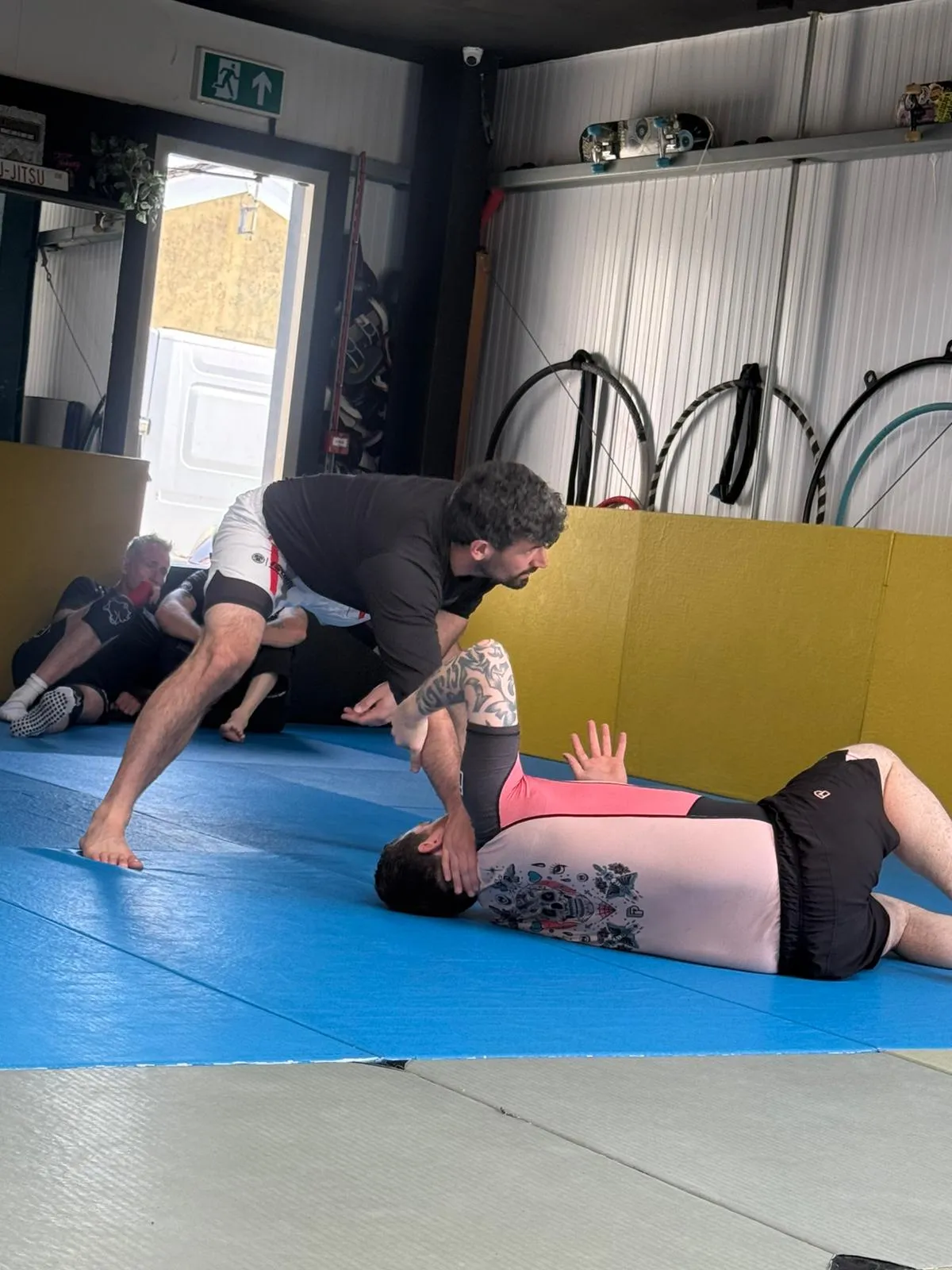
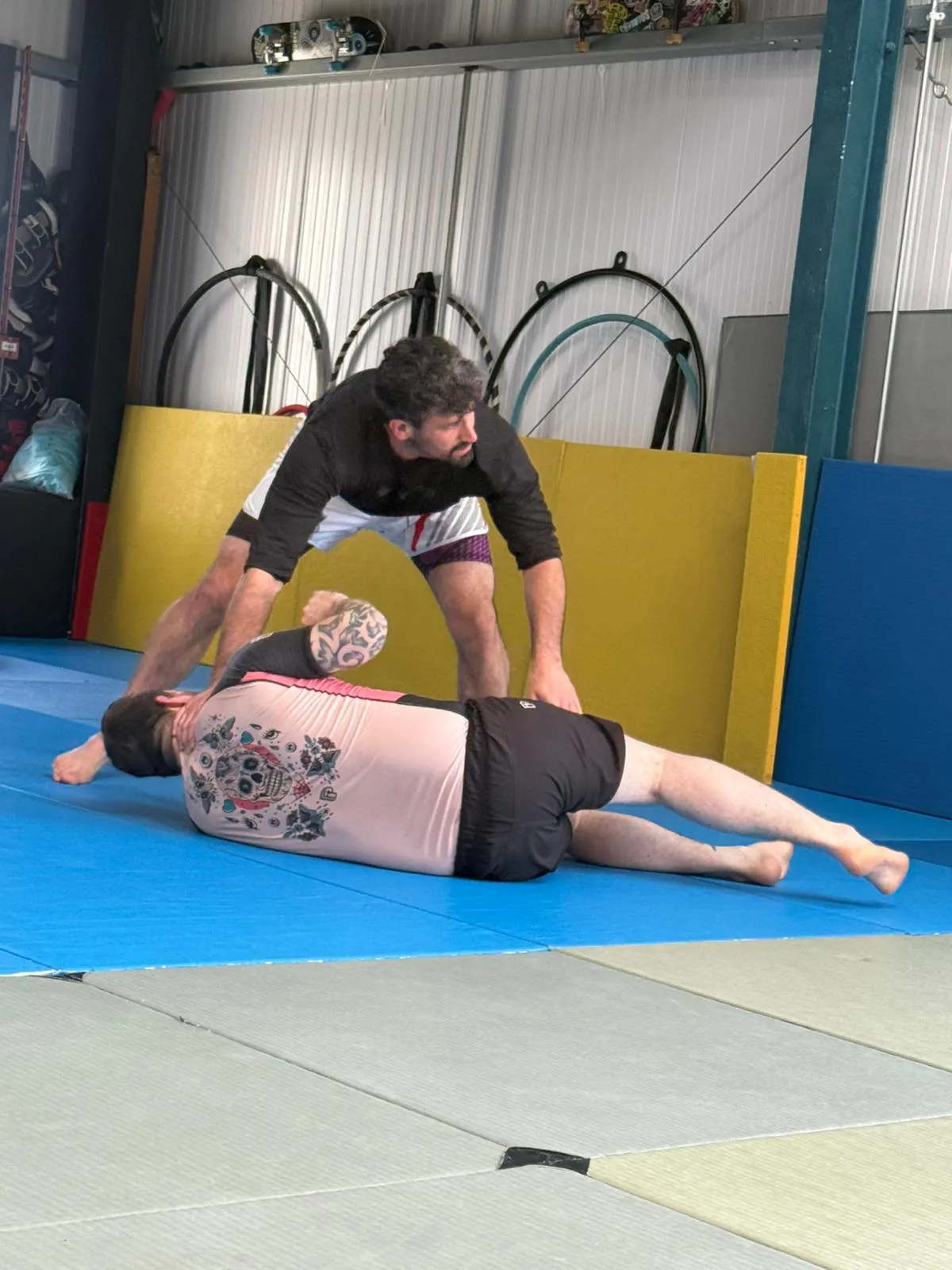
No-gi means grappling without a kimono. No jacket to grip, no trousers to hold. Shorts and a rash guard. The game is wrestling combined with submission grappling — you're working to control your opponent, escape their control, and apply submissions (joint locks, chokes). No striking. You learn to be safe, to keep people safe, and to move well.
It's one of the fastest-growing combat sports in the world right now, for good reason: it rewards athleticism and technique in roughly equal measure, and the feedback is immediate. You either held the position or you didn't.
You don't need to arrive ready
You don't need to be fit. You don't need to be flexible. You don't need prior martial arts experience. You don't need to be tough — whatever that means. The first session is structured so you know exactly what's happening, who you're training with, and what's expected of you. You'll be told what to wear (shorts and a t-shirt or rash guard is fine to start), where to go, and what the session will look like.
Everyone in that room started with no idea what they were doing. That includes the people who are now good at it.
The club is welcoming to women, older beginners, and people who've never set foot on a mat. That's not a line — it's something we actively make true by how sessions are run and how experienced members are expected to train with new ones.
Real feedback. Real criteria.
We don't chase belts, and we don't organise the room around them. In most gyms a belt measures time served and instructor approval; here it can only ever measure how well you grapple, because it's earned against written criteria. Chasing it is still the wrong goal — the skill is the goal, and rank follows.
Here, progress is what you can do. You'll feel it: the position you used to lose in thirty seconds, you're now holding for a minute and working from. The submission you kept missing, you're now hitting consistently. The roll that felt chaotic, you're now moving through with a plan.
We'll tell you explicitly what you're working on at any given stage, and we'll tell you whether it's moving. That's a better feedback system than a colour alone.
Rank still matters — competition requires it, and it should mean something. Belts here are earned against a written syllabus — performance criteria, not time served. Standard BJJ belts, one rank across both gi and no-gi, no ceremonies, no politics. The syllabus is available to members. We also run free assessments against the standards at ingrappling.com — a grappling standards resource our head coach, Ben Zarif, also owns and runs. That's an outside benchmark, separate from your belt.
Next — Striking is coming, same lens: coached as a sport, science over mysticism. We're building grappling properly first. Watch this space.
Two weeks free.
Come and see how it feels.
No card, no commitment. Show up, train, and decide from there.
Book a free trial →