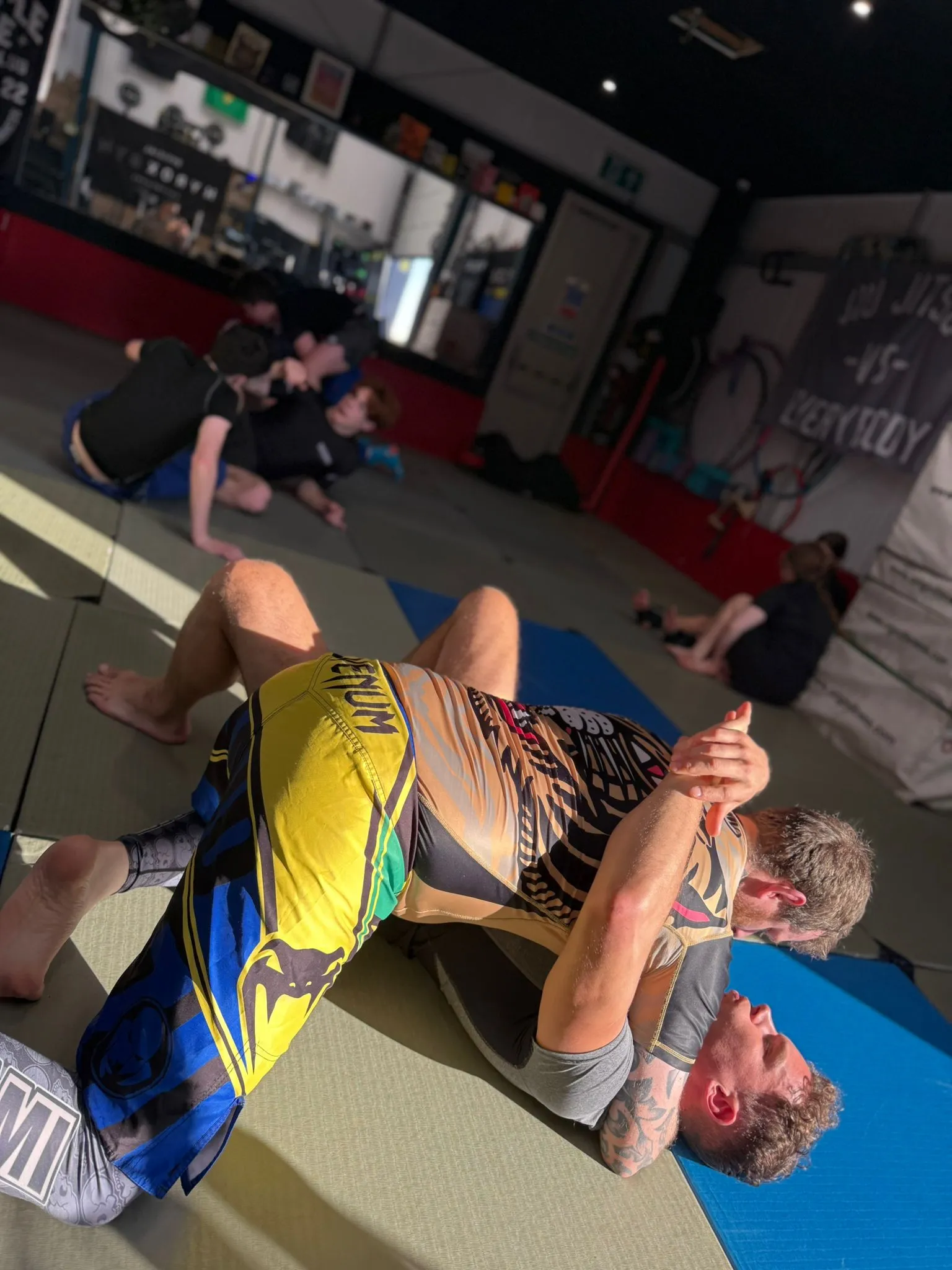
Why we train no-gi

I get asked this in the first week, every time: “Do I need a gi?” No — not for submission grappling. That’s the sport we run: shorts and a rash guard, and it’s a deliberate choice, not a shortcut.
Here’s the short version. Gi and no-gi are really two different sports. The gi adds a whole layer — grips on the collar, on the sleeve, control built on the jacket — and it takes years to master properly. No-gi takes the jacket out of the equation and builds on what’s left: your hands on their body, your weight, your positioning, your timing. We’ve built the club around no-gi because it’s the sport we want to coach — not because the other one is a lesser thing. Gi BJJ runs at Rebel too, run by Adrian, as its own sport.
When there’s nothing to grab but the person in front of you, you find out very quickly what actually works.
I want you good at the grappling underneath — position, weight, timing, the things that carry across every ruleset. You should control a position because you understand it, not only because you’ve got a fistful of lapel. That’s the game we coach here.
It’s closer to the real thing
There’s a practical argument too. Nobody you meet outside the gym is wearing a gi. If any of this ever has to work in a scrappy, unplanned moment, it will be against a t-shirt, a jacket that tears, or bare skin — sweaty, fast, and grip-light. No-gi trains for that reality. It also happens to be where the sport is going: the biggest events and the most-watched matches are no-gi. We coach this as a sport — see our take on submission grappling — and the sport is moving this way.
Faster feedback, fewer rituals
No-gi is quicker. Rounds move faster, scrambles happen more often, and you can’t stall behind a grip. That means more repetitions, more problems to solve, and more honest feedback per session — which is the entire point of training if you actually want to get good.
And there’s the part I care about most: with no jacket there’s no belt on it. Nobody’s rank is on display, and nobody is waiting years for permission to feel like they have improved. You will know you are improving because last month’s problem stops being a problem. Rank still exists — competition requires it, and we certify it against written criteria — but on the no-gi mat it stays where it belongs: in the background.
What it means for you on day one
Bring shorts without pockets or zips, and a rash guard or a plain t-shirt. That is it. No kit to buy, no uniform to break in, nothing that marks you out as new. You put on the same thing everyone else is wearing and you start learning the actual skill from the first minute.
If that sounds like the training you have been looking for, come and try it. The first two weeks are free — book a trial and see how it feels with nothing to hide behind.