Starting grappling as an adult

Most people who start grappling here are somewhere between twenty-five and forty-five, have a job, and haven’t been a beginner at anything for fifteen years. That last part is the real obstacle, and nobody talks about it.
Starting a sport as an adult is a different problem to starting one as a kid. Kids have unlimited time, no dignity to protect and a body with no history. You have none of those things. So here’s the adult version.
Being bad at something in front of strangers
This is the actual barrier. Not fitness, not injury, not the training — the prospect of standing in a room full of competent people and being visibly the worst one there.
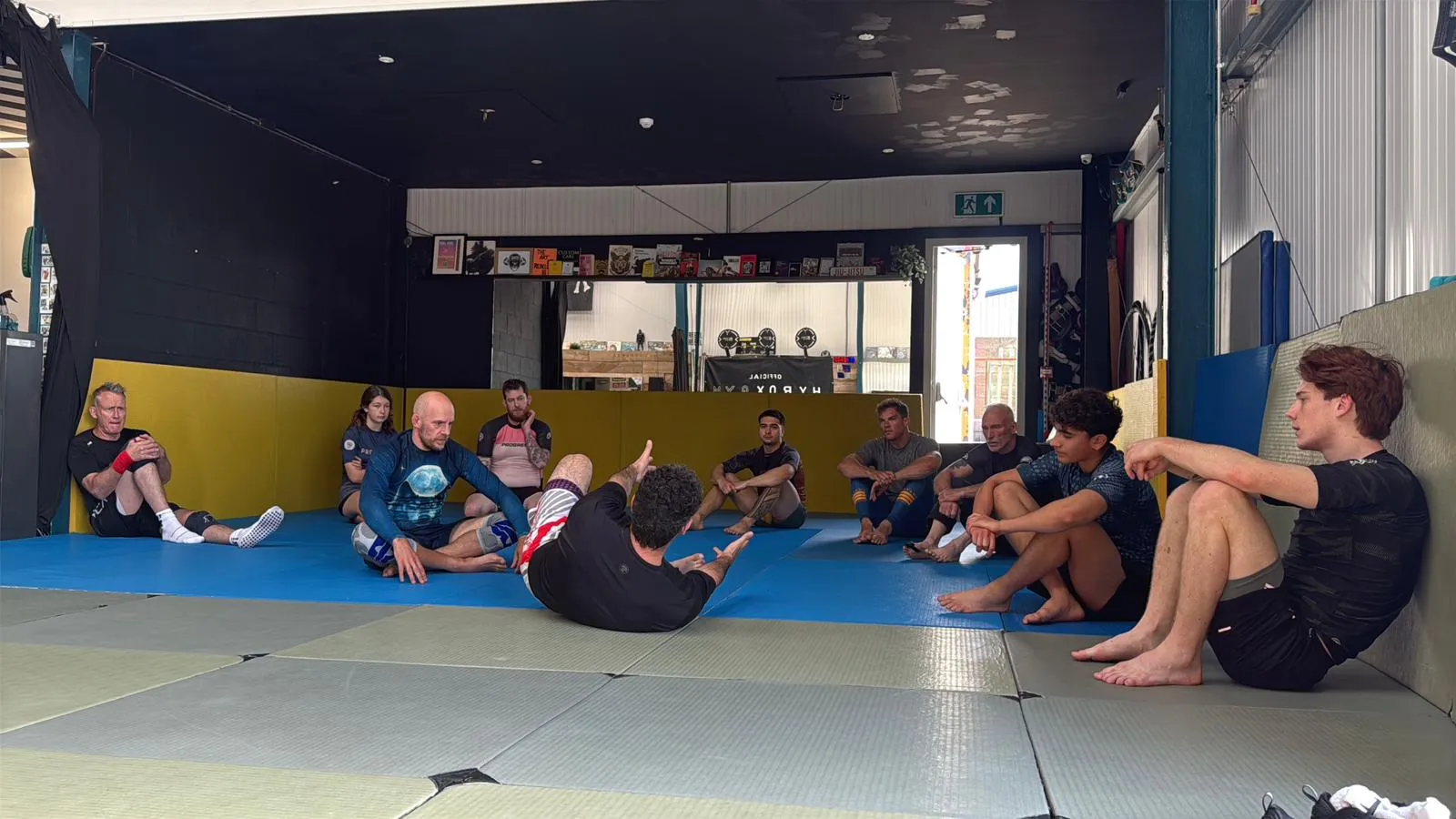
You will be the worst one there. For a while, in a specific and limited way: you’ll be worse at grappling than people who have been grappling longer. That’s arithmetic, not judgement. What surprises people is how completely nobody cares. Everyone in that room was new, most of them recently, and watching a beginner struggle is about as interesting to them as watching someone learn to drive. They’re busy with their own problems.
Being new is not a status. It’s a date on a calendar, and everyone in the room has one.
The thing that actually helps is dropping the idea that you should be able to do this already. You can’t, yet. Adults who can sit in that for a few weeks tend to learn faster than anyone — they ask better questions, they regulate their own intensity, and they don’t need to win the round to enjoy it.
Time — and how little you actually need
Two sessions a week is a real training programme. Not a compromise, not a holding pattern — genuine progress, and enough that in a few months you’ll be a different grappler to the one who walked in. Three is better if your week allows it. One is slow but still beats nothing.
The people who blow up aren’t the ones training twice a week. They’re the ones who go all-in for a month, train five times a week around a full-time job, get run down, tweak something, and quit. Pick a number you can hold for a year and hold it. That’s how the hours actually add up.
An older body, honestly
You don’t need to get fit first — you get fit by doing it. But an adult body usually comes with history: a shoulder, a lower back, a knee that complains. Tell us on day one. That’s not a confession, it’s information we need, and every single thing we run can be adjusted around it.
Then use the tap freely. Tapping early is the single skill that keeps adults training for decades, and being slow to tap is how people get hurt. Nobody is keeping score of your taps. Your partners are tapping too.
You’ll also be sore in unfamiliar places for the first couple of weeks — grappling uses muscles nothing else in normal life touches. It settles quickly, and if you want to make your body more robust while it does, Adrian’s take on strength work is the sane version.
Gi or no-gi — either is a fine door
You can start in either. Our no-gi classes are shorts and a rashguard: faster, more scrambling, nothing to grip but the person. Gi BJJ runs here too as its own sport, with Adrian running those classes — slower, more grip-based, more of a chess game.
Neither is the “proper” one and neither is the beginner version. Pick whichever appeals, and if you turn out to like both, they share one rank here, so nothing is wasted either way.
Two sessions a week, held for a year, beats five sessions a week held for a month. Every time.
What the first month is really like
Week one you’ll be tense and confused. Week two something small will click — an escape you didn’t have to think about. By the end of the month you’ll have a rough sense of where you are in a position, which is the thing that makes rolling feel like a puzzle instead of a panic. That’s the point everyone starts enjoying it, and it arrives faster than you expect.
Everything else a beginner needs is here, and the first two weeks are free — no card, no commitment. Book a trial and start at the age you actually are.